
When you read “Nasdaq” you may be looking at three different things: a stock market, a very broad index and a selective index. Before interpreting a news item or the factsheet of an ETF, a fund whose shares are bought and sold on an exchange, you need to know which one is meant.
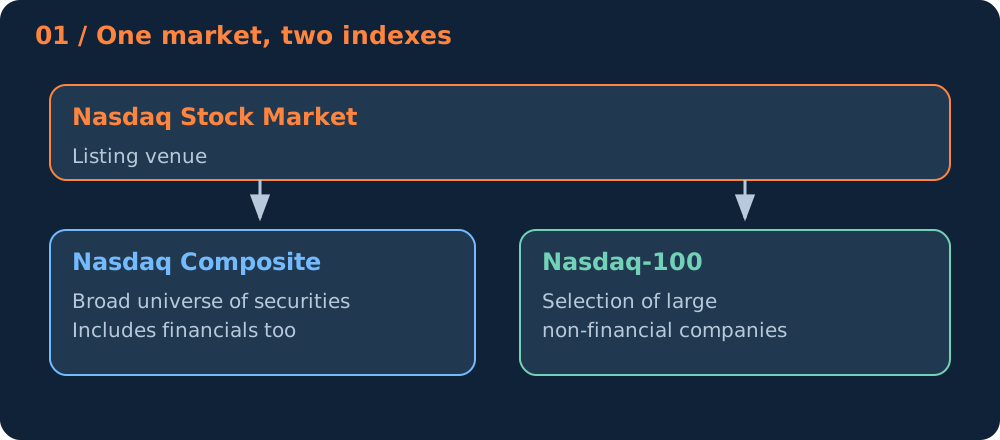
The Nasdaq-100 is built to represent 100 of the largest non-financial companies listed on the eligible Nasdaq markets. Weighting is by modified market capitalisation: size matters, but with adjustments and caps. [S1]
Two misunderstandings to clear up at once. The Nasdaq-100 is not “the technology index”: the sector requirement is the exclusion of financial companies, not membership of technology. And it is not “the index of American companies”: the universe is open to domestic and international companies, provided the primary listing is on a US Nasdaq market. [S1] [S9]
What changed on 1 May 2026
On 30 March 2026 Nasdaq closed a public consultation and approved a revision of the methodology, effective 1 May 2026. From 1 May the “10 basis point rule” and the intra-quarter updates of shares outstanding ceased, and Fast Entry began; for existing constituents the float cap and the ranking by full market capitalisation were applied at the June 2026 rebalance. [S7] [S3] It is the most important change in years, and it alters how to read many explanations found online that were written under the previous rules.
Who can get in
To be eligible a company must: [S1]
- have its primary listing on a US Nasdaq market, excluding the Nasdaq Capital Market;
- not be classified in the Financial industry under ICB (Industry Classification Benchmark, the sector classification the index uses); real-estate companies are eligible, provided they are not organised as a REIT (a listed real-estate investment trust);
- not be a SPAC (a listed shell company created to acquire a business) nor a “when-issued” security, i.e. one traded before the shares are actually issued;
- have average daily traded value of at least 5 million US dollars over the previous three months;
- have been listed for at least three full calendar months, excluding the month of initial listing, on one of the markets the methodology accepts, except under Fast Entry, explained later.
Being eligible means being assessable. Being selected means winning a place through the procedure. Think of a course with limited places: first you check who meets the requirements, then you rank the eligible candidates. Passing the first check does not guarantee a place. For the same reason, avoid the phrase “the hundred best”: the methodology builds a representation, it does not grade the prospects of each candidate.
100 companies, not necessarily 100 securities
A company is the business; a share class is a category of that company’s shares, possibly with different rights. The methodology admits several classes of the same company. [S1]
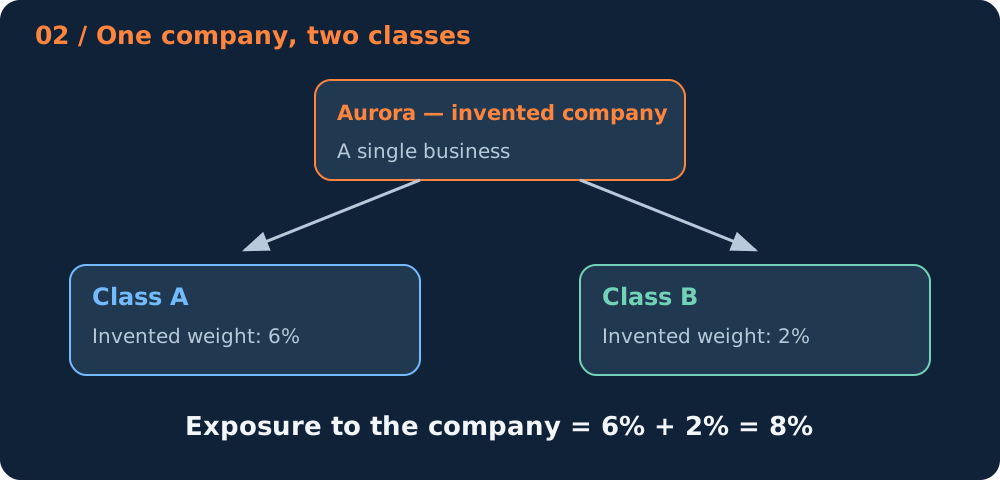
If the invented company Aurora has two eligible classes, it remains one company but occupies two rows in the index. Counting rows and counting businesses answer different questions. If class B disappeared from the list, the securities would drop by one but the businesses represented would stay the same. The distinction matters later, when concentration caps apply sometimes to the company and sometimes to the single security. Nor is the number 100 rigid: Fast Entry may temporarily take the constituent count above one hundred. [S1]
The annual selection in December
In December all eligible companies are ranked by market capitalisation and the procedure runs in this order, until it reaches 100: [S1]
- 1.the top 75 of the ranking are selected;
- 2.current constituents ranked between 76th and 100th are retained;
- 3.if places remain, current constituents ranked 101st to 125th are retained in rank order, provided they were in the top 100 at the previous reconstitution or were added afterwards;
- 4.any remaining places go, in rank order, to new companies within the top 100.
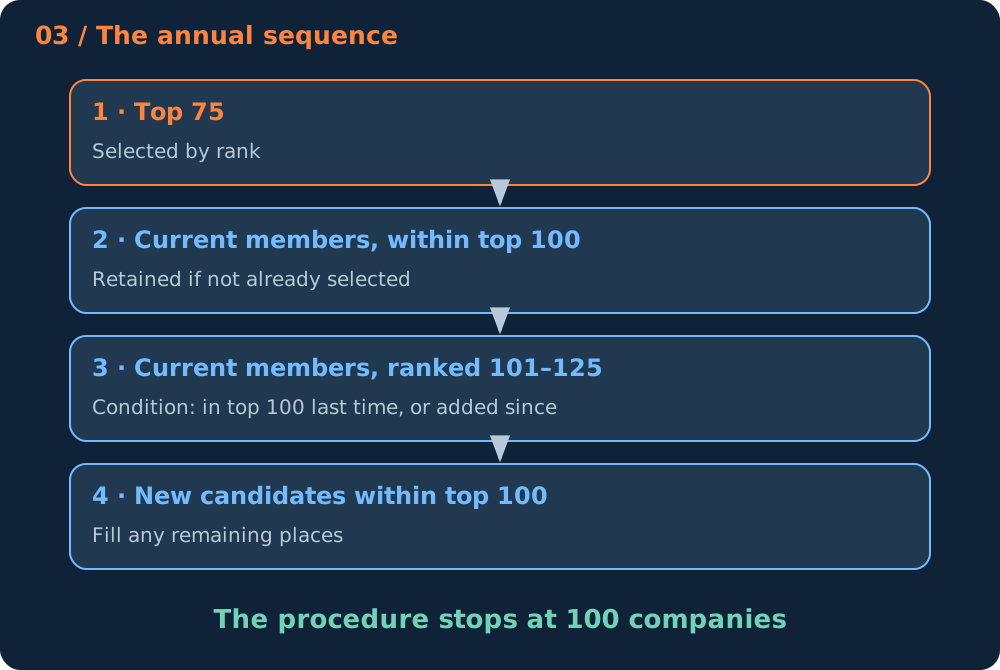
Rank is therefore not the only element: already being in counts too. Boreale, a current constituent ranked 105th, is not automatically out; Cobalto, new and ranked 95th, is not automatically in. For Boreale you check the step 3 condition and whether places remain; for Cobalto, how many places are left when the procedure reaches step 4. The example does not say which of the two gets in: the information is deliberately missing. It shows that one number is not enough.
Two questions, two market capitalisations
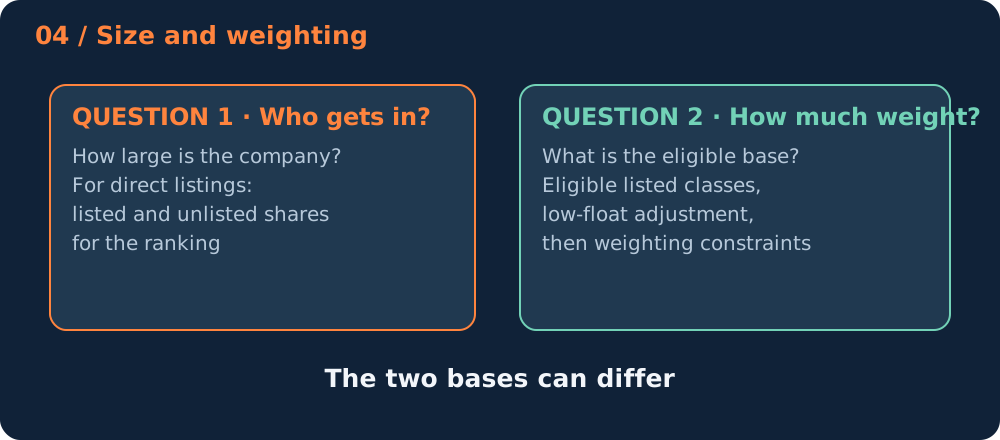
“How large is the company?” and “how much does it weigh in the index?” use different bases. [S1]
- For ranking, full market capitalisation is used: for direct listings and primary ADRs, the value of all shares, listed and unlisted; for non-primary ADRs, only the value of the listed receipts, without the underlying foreign shares.
- For weighting, modified market capitalisation is used: only eligible listed classes count, with the float cap explained below.
An ADR (American Depositary Receipt) is a certificate traded in the United States that represents shares of a foreign company. Nasdaq distinguishes the primary ADR, which is the company’s main listing in the world, from the non-primary ADR, where the main listing is on a foreign exchange. [S1]
Why two bases? A business may have an unlisted class held by its founders: it describes the company’s size, but it is not a security an ETF can buy. The first question counts it, the second does not.
One last distinction, because it recurs in factsheets: market capitalisation is price times number of shares, not revenue or profit. Lumen has one million shares at 100 euros: capitalisation 100 million. Prisma has ten million shares at 20 euros: 200 million. The lower share price does not make the company smaller, just as the price of a slice does not tell you how big the cake is.
The float cap: three times, no more
Float is the part of the shares that the index considers genuinely available for trading; controlling or strategic holdings are left out. For weighting, the value of eligible listed shares is limited to the lower of their total value and three times the value of the float. [S1] [S3]
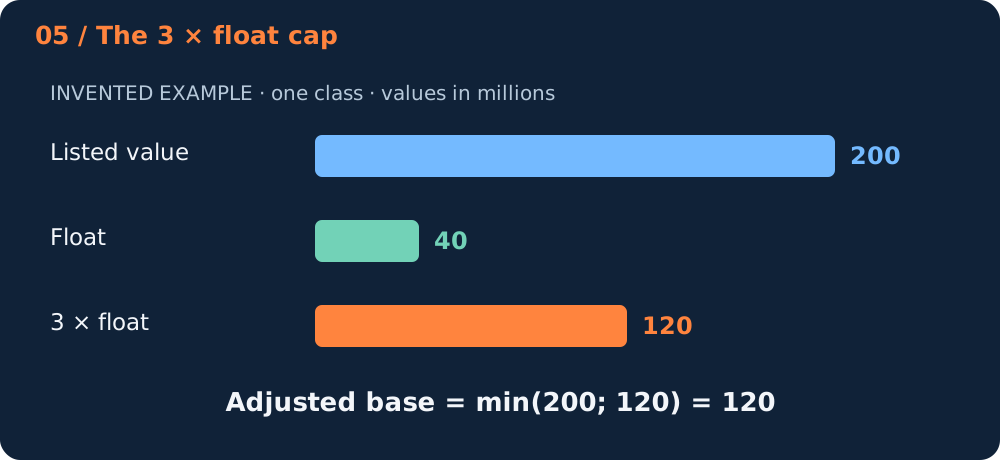
A fully listed class is worth 200 million and its float is worth 40: the cap is 3 × 40 = 120, the adjusted base is 120. If instead the float is worth 100, the cap is 300 and the base stays at 200: the adjustment never reduces anything when the float is wide, and never lifts the base above the real value. The 120 million is not a weight and not an amount to buy: the weight comes from the ratio to all the other constituents, after the caps that follow.
Nasdaq explains the choice this way: the index has always been weighted by market capitalisation, not by float; under the old 10% minimum a security could weigh up to ten times its float, now at most three. [S3]
Modified weighting: the caps and where the removed weight goes
In simple weighting every value is divided by the total. In modified weighting caps intervene, and the weight taken from one constituent must be redistributed to the others, otherwise the weights would no longer add up to 100. [S5]
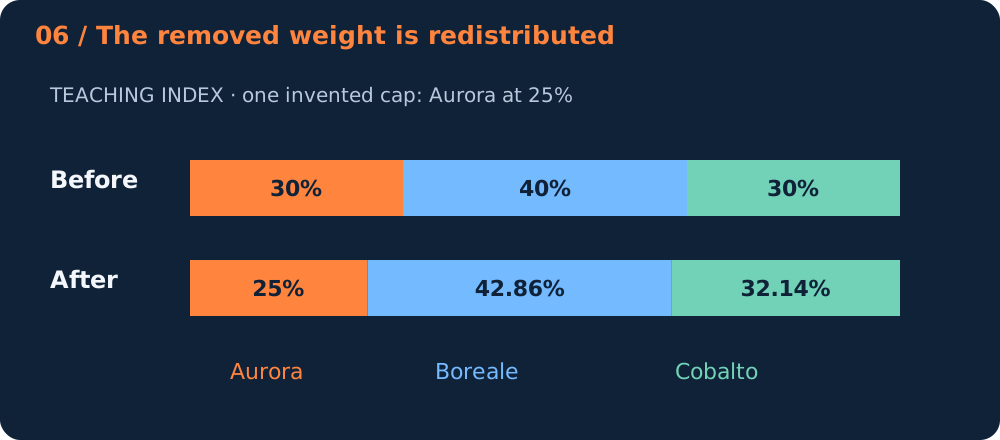
The five points taken from Aurora go to the other two in proportion to their weights (5 × 40/70 and 5 × 30/70). The 25% is invented: it only shows the redistribution. The real caps are these, applied at different levels: [S1]
March, June and September rebalances (company level)
December reconstitution (company level, then security level)
For each level, if a constraint is still breached after the two stages, the process is repeated until both constraints are satisfied. We report the document’s wording without adding interpretations: in the quarterly rebalances company stage 2 is written as a standalone check, in December the two company stages are written under the 24% condition, and security stage 2 is written as a standalone check. The 24% and 15% are trigger thresholds, not observed weights nor limits held every day: between one review and the next, weights move with prices. If between one review and the next a company exceeds 24%, or the companies above 4.5% together exceed 48%, Nasdaq may call a special rebalance. [S1]
Why the calendar matters
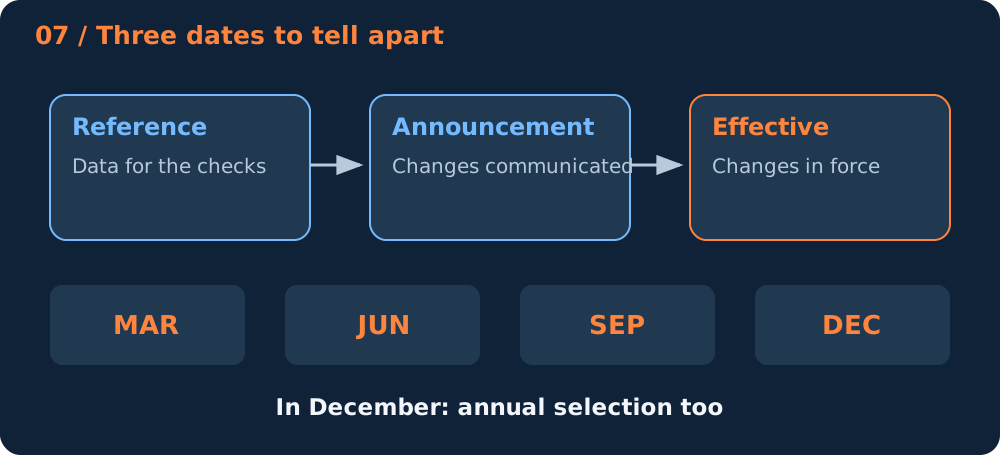
Ordinary changes take effect at the open of the first trading day after the third Friday of the month. [S1] Three dates must be kept apart: the reference date is the snapshot used for the calculations, the announcement communicates the changes, the effective date makes them operational. An announcement does not describe a composition already in force.
Between two reviews the weights move on their own. An invented basket with 50 euros of Aurora and 50 of Boreale weighs 50 and 50; if Aurora rises to 60, it weighs 60/110, about 54.5%, without anyone buying anything. That is why a percentage fixed in a procedure is not a frozen number.
The quarters change companies too
Since 2026 the rule that removed whoever weighed too little has been replaced by a quarterly ranking check: companies ranked beyond 125th are removed, lowest first, and if the count drops below 100 they are replaced by the largest eligible company outside the index. [S1] [S2] “In December the companies change, in the other months only the weights” is no longer true.
Fast Entry lets a company that ranks within the top 40 of the index by full market capitalisation join without waiting for December. For a new listing the ranking is taken at the seventh trading day, the announcement at the tenth and entry normally after the fifteenth, with the timetable adjusted if it falls near an ordinary review. The three-month listing requirement does not apply; the 5 million daily traded value does, measured from the first day. Whoever enters this way pushes nobody out, and the index may temporarily count more than 100 companies. [S1] [S3]
“Trading days” are not calendar days: the fifteenth trading day is not found by adding fifteen days to the debut date. And Fast Entry is not a shortcut for any newcomer: the threshold is relative, you must rank among the top 40 companies of the index by size. Nasdaq notes that in March 2026 this corresponded to market capitalisations above 100 billion dollars: an order of magnitude that moves with the market, not a threshold. [S3]
Corporate events between reviews, such as mergers, spin-offs and splits, follow the dedicated manual. [S6] A split that turns one million shares at 100 euros into two million at 50 creates no value: it changes the number of units, not the total. The index applies rules so as not to confuse a change in the instrument with an economic result.
One index, three calculation versions
Nasdaq calculates the Nasdaq-100 in three versions that treat dividends differently: [S4]
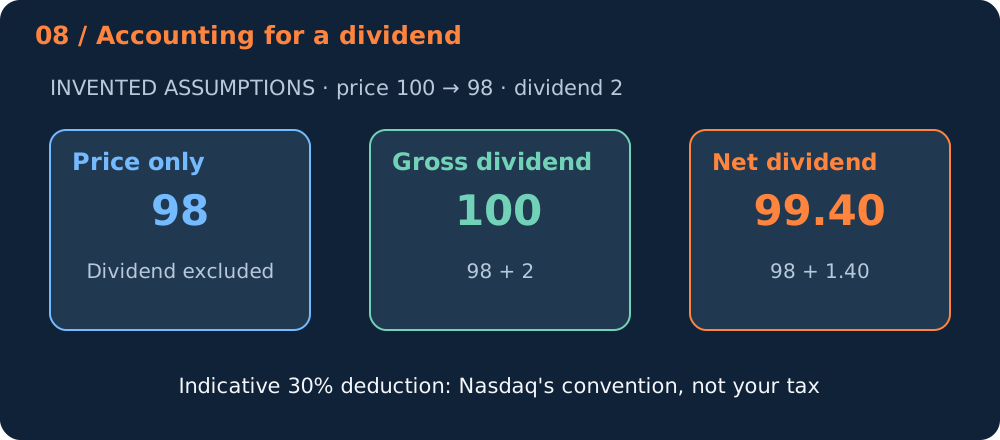
A teaching security at 100 euros pays a 2-euro dividend and, to isolate the mechanism, falls exactly to 98. Looking at the price alone you find 98; with the gross dividend 100; with the notional 30% deduction you find 98 + 1.40 = 99.40. The 30% is the index’s convention, not the reader’s tax. It is not a return comparison between real versions: in reality the price moves for many other reasons.
Two levels not to confuse: the index version describes a calculation; an accumulating or distributing share class describes the fund’s income policy. Why three versions exist and what it means for a European ETF is explained in the episode “Net, Gross, Price: why one index has three returns”, written on MSCI but valid for every provider.
From the index to the ETF factsheet
The index is the reference, the ETF is the fund that tries to replicate it. In the Rebalix registry many funds declare the Nasdaq-100 as their benchmark. The label UCITS in their names marks funds harmonised under European rules, the ones a saver in Europe can buy. The very way they name the index shows why the version must be read:
Four funds, the same index, two ways of naming it, two replication methods, two income policies. Before comparing two ETFs “on the Nasdaq-100”, read at least these four lines in the factsheet and in the KID, the mandatory three-page information document that accompanies every fund sold in Europe: exact name and version of the index, replication method, income treatment, any currency hedging. The difference between physical and synthetic replication is explained in “Physical and synthetic replication”; accumulating versus distributing in “Accumulating or distributing ETFs”.
Same brand, different indexes. The registry also lists products whose name contains “Nasdaq-100” but which track another index: the ESG variant, which applies environmental, social and governance criteria, the “Top 30” and “ex-Top 30”, the “Next Generation 100”, the “Target Income”, plus leveraged and inverse products, which target a multiple of the daily move and do not deliver the same multiple over a year. A similar name does not fill a missing piece of information: look for the full name of the index.
You do not buy the index, you buy fund shares. The exchange price of a share can differ from its net asset value, i.e. the fund’s assets divided by the number of shares (NAV for short). Trading costs and the spread, the gap between the buying and the selling price at the same moment, belong to the product and the transaction, not to the index: they are explained in the ETF Guide, in the chapters on price, net asset value and spreads.
Explore the index on Nasdaq’s site
This guide explains the rules. The index snapshot, kept up to date by Nasdaq, lives on its public pages: four destinations, each with one precise thing inside.
- Index page: the Nasdaq-100 value and chart, key facts and the links to the official documents (methodology, change log, factsheet).
- Constituents and weights: the list of the index’s securities with each one’s weight, as of the date shown on the page.
- Value history: the index’s daily values, browsable by period.
- Factsheet (PDF): the ten largest securities by weight, the sector breakdown and performance, with the reference date printed in the document. Nasdaq refreshes it monthly.
The pages belong to Nasdaq and change with the index: this guide neither copies nor summarises them, but tells you what to look for in each once you understand the rules.
The guide in one table
Frequently asked questions
Does joining the Nasdaq-100 mean a company will go up?
No. Admission is the outcome of a procedure, not a forecast of the price.
Where do I find today’s constituents and weights?
On Nasdaq’s public pages linked in the section “Explore the index on Nasdaq’s site”: constituents with weights, value history and the monthly factsheet. This guide teaches you how to read them; the names and percentages in its examples are invented.
Can I derive the weight from the rank?
No: rank tells you who comes first, not how far apart the values are, and after the ranking the caps intervene.
Do more securities mean more diversification?
Not necessarily: Aurora A and Aurora B remain the same business, and different companies may depend on the same customers or factors.
Are the examples a backtest?
No: they use no historical prices, real companies or index returns. They show an arithmetic identity with stated assumptions.
How this guide is updated
The rules told here were verified on the official documents on 2 October 2026 and apply to the methodology in force since 1 May 2026. A periodic automatic check, once a month, re-reads the monitored sources: the methodology documents published by Nasdaq and the index’s document list on its site. It compares the numbers this guide states with those it finds and flags to the editors every threshold, procedure, effective date or new document: a person re-reads the source and corrects the guide by hand. No sentence is ever rewritten by a machine, no index data is collected, and a failed check shows as failed, not as “nothing new”. The check is periodic: a change may be detected after it takes effect. The revision date changes only when the content is actually re-examined; revisions are listed below.
Primary sources
- S1 — Nasdaq-100 Index Methodology, Nasdaq, 2026 edition: eligibility criteria, market capitalisation determination, annual reconstitution, quarterly and special rebalances, Fast Entry.
- S2 — Nasdaq-100 Methodology Change Log, Nasdaq: rows effective 1 May 2026.
- S3 — Nasdaq-100 Methodology Changes FAQ, Nasdaq, July 2026 (additions of 31 July): timing, Fast Entry, float cap, replacement of the 10 basis point rule.
- S4 — Nasdaq-100 Index Versions, Nasdaq: Price, Gross and Notional Net Total Return versions.
- S5 — Nasdaq Index Weight Calculations, Nasdaq, 20 May 2026: initial and final weights, cap levels.
- S6 — Corporate Actions and Events Manual — Equities, Nasdaq.
- S7 — Nasdaq Concludes Public Consultation on the Nasdaq-100 Index, Nasdaq press release, 30 March 2026.
- S8 — Nasdaq-100, official index page: composition and current data (not reproduced here).
- S9 — What is the Nasdaq-100? and Nasdaq Composite vs. Nasdaq-100, Nasdaq Newsroom, 2026: used only for the distinction between market and indexes.
- S10 — Rebalix ETF registry (data declared by issuers in KIDs and factsheets, as of 2 October 2026): pages of the four ISINs cited.